The right acoustic ceiling solution can turn an echoing room into one that feels calm, clear and comfortable. Modern interiors love hard surfaces — glass, marble, concrete, polished floors — but those surfaces bounce sound around. The result is echo, raised voices and meetings where nobody can quite hear each other.
The ceiling is usually the largest uninterrupted surface in any room. That makes it the most effective place to control noise, without giving up wall space or floor area.
In this guide, we explain the main acoustic ceiling systems — from acoustic ceiling baffles to seamless acoustic stretch ceilings — and how to choose the right one for your office, restaurant or home cinema.
What are acoustic ceiling solutions?
Acoustic ceiling solutions are ceiling systems designed to absorb sound instead of reflecting it. They reduce reverberation (the lingering echo after a sound) so speech is clearer and background noise feels lower.
The most common acoustic ceiling systems are:
Acoustic ceiling baffles — vertical panels hung from the ceiling that absorb sound on both faces.
Acoustic stretch ceilings — a perforated membrane stretched over a sound-absorbing layer for a smooth, seamless finish.
Acoustic fabric ceilings — fabric-wrapped systems that combine soft texture with sound absorption.
Noise reducing ceiling panels — flat or shaped panels (clouds, rafts, tiles) fixed or suspended below the ceiling.
Performance is usually rated by NRC (Noise Reduction Coefficient), from 0 (reflects all sound) to 1 (absorbs almost all). Most quality acoustic panels sit between 0.7 and 0.95, depending on material and installation depth.
Acoustic ceiling baffles: sound control you can see
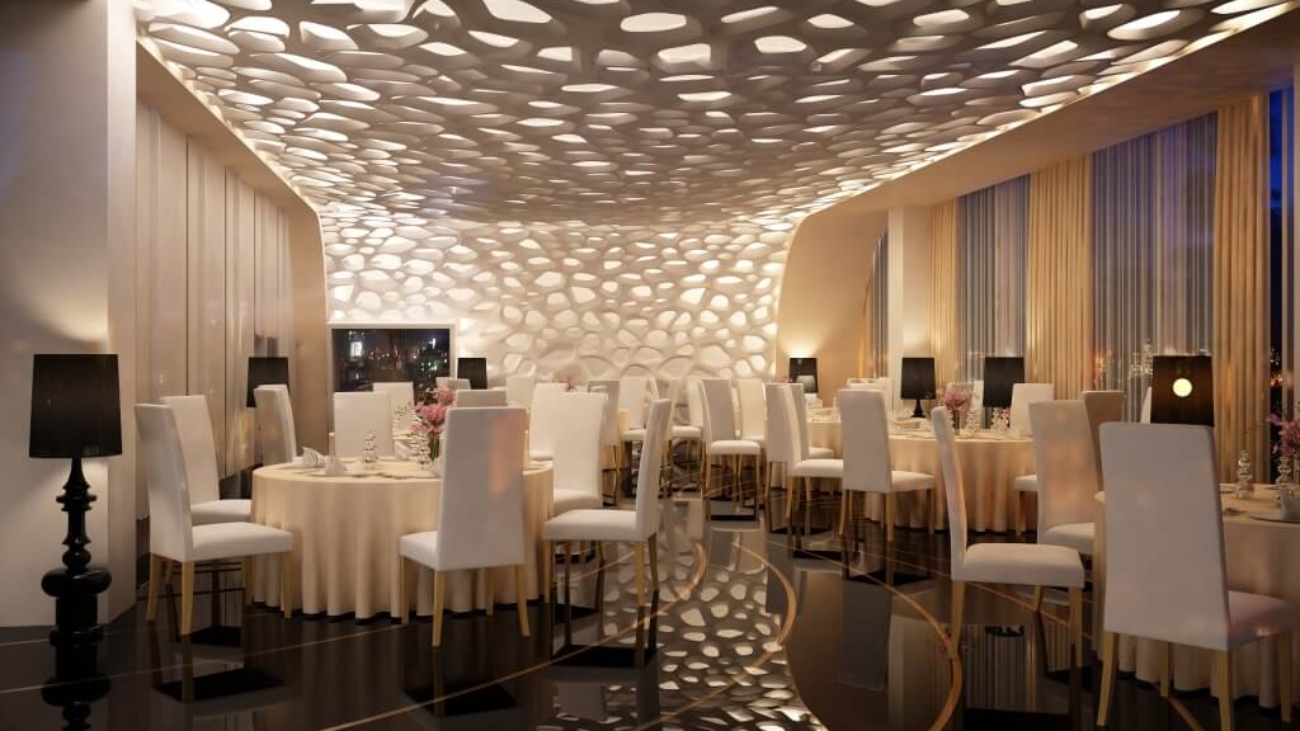
Acoustic ceiling baffles are one of the most effective and stylish ways to control noise in large, open spaces. Because hanging acoustic baffles are suspended vertically, sound hits both faces and the edges — giving more absorbing surface than a flat panel of the same footprint.
Types of acoustic baffles
Type
Best for
Why choose it
Felt acoustic ceiling baffles
Offices, schools, cafés
Lightweight PET felt, often recycled, available in many colours
Suspended acoustic baffles
Atriums, lobbies, open-plan floors
Hung on cables at adjustable heights, ideal for high or exposed ceilings
Decorative acoustic baffles
Restaurants, retail, hospitality
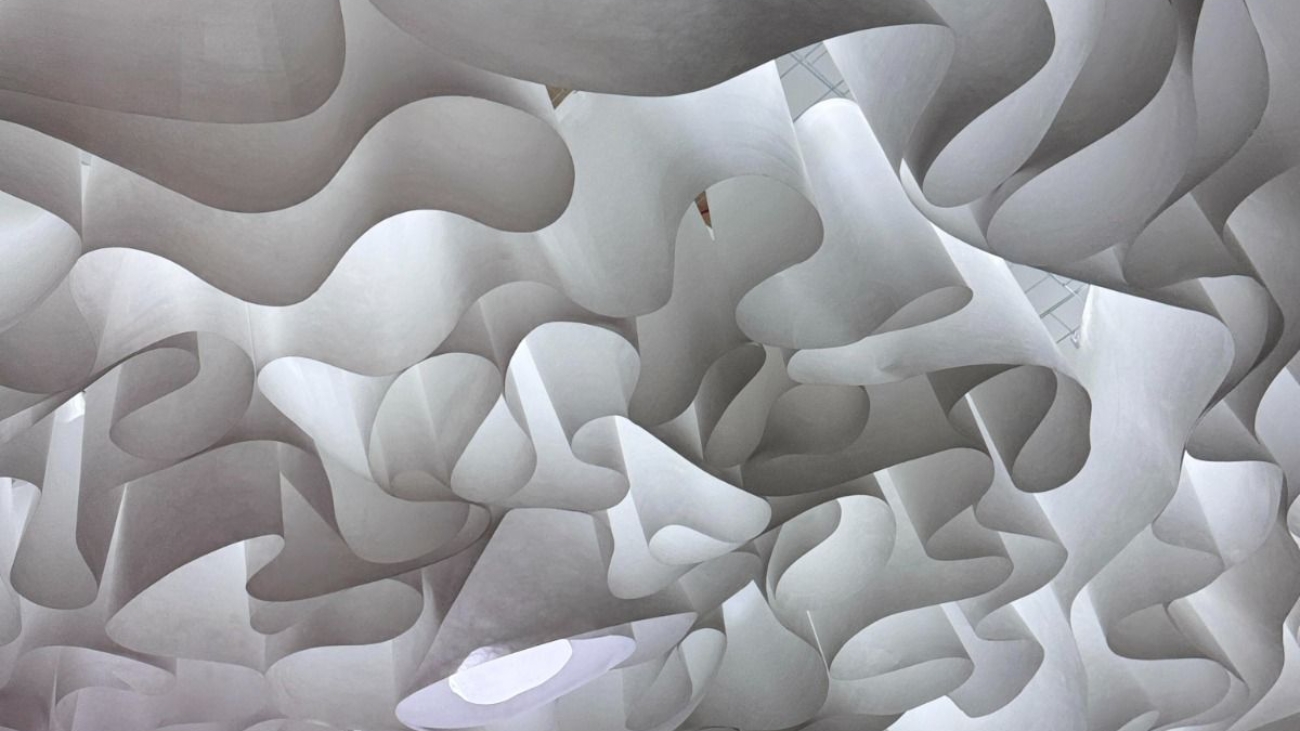
Curves, waves and custom shapes that double as a design feature
Sound absorbing ceiling baffles (fabric-wrapped)
Meeting rooms, auditoriums
High NRC with a soft, premium finish
Why a baffle ceiling works so well
Keeps services accessible — an acoustic baffle ceiling system leaves space for lighting, HVAC and sprinklers.
Suits exposed ceilings — perfect for industrial-style interiors where a full false ceiling is not wanted.
Flexible layouts — run baffles in straight lines, grids, waves or clusters to shape both sound and style.
Quick to install — a modular baffle ceiling can go up with minimal disruption to a working space.
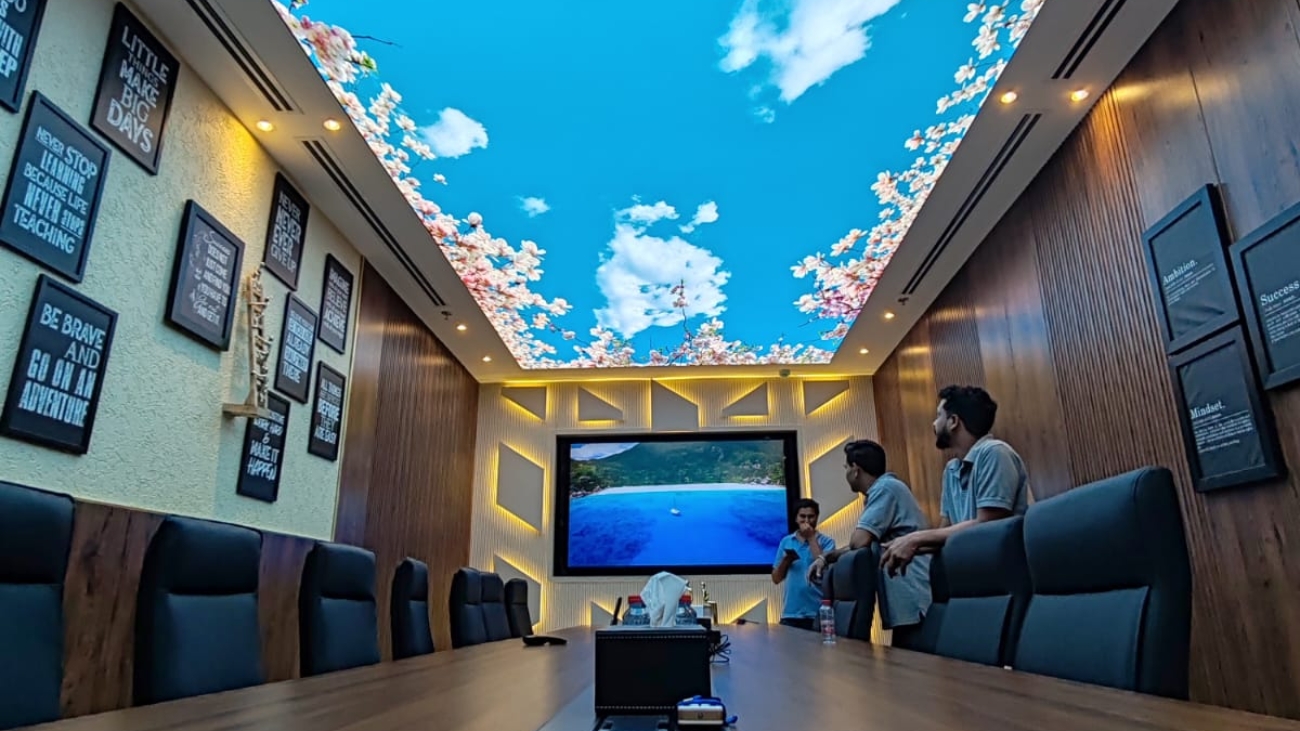
An acoustic stretch ceiling gives you a perfectly smooth, seamless acoustic ceiling that absorbs sound as well as it looks. It is the go-to choice when you want noise control without visible panels, joints or grids.
How a perforated stretch ceiling works
A perforated stretch ceiling uses a membrane with thousands of micro-perforations. Sound passes through the tiny holes and is absorbed by an acoustic layer (such as mineral wool or acoustic foam) installed in the void above. From below, the surface looks like a clean, continuous ceiling.
Acoustic fabric ceiling vs perforated film
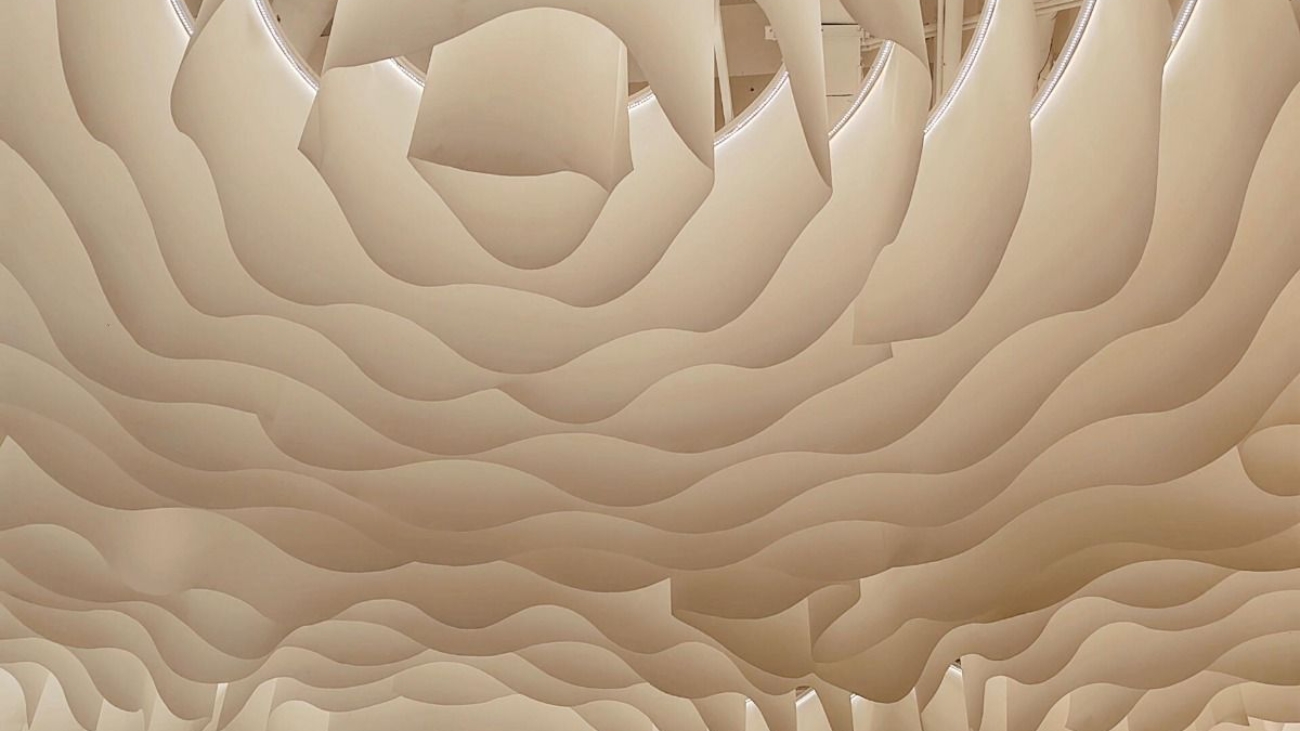
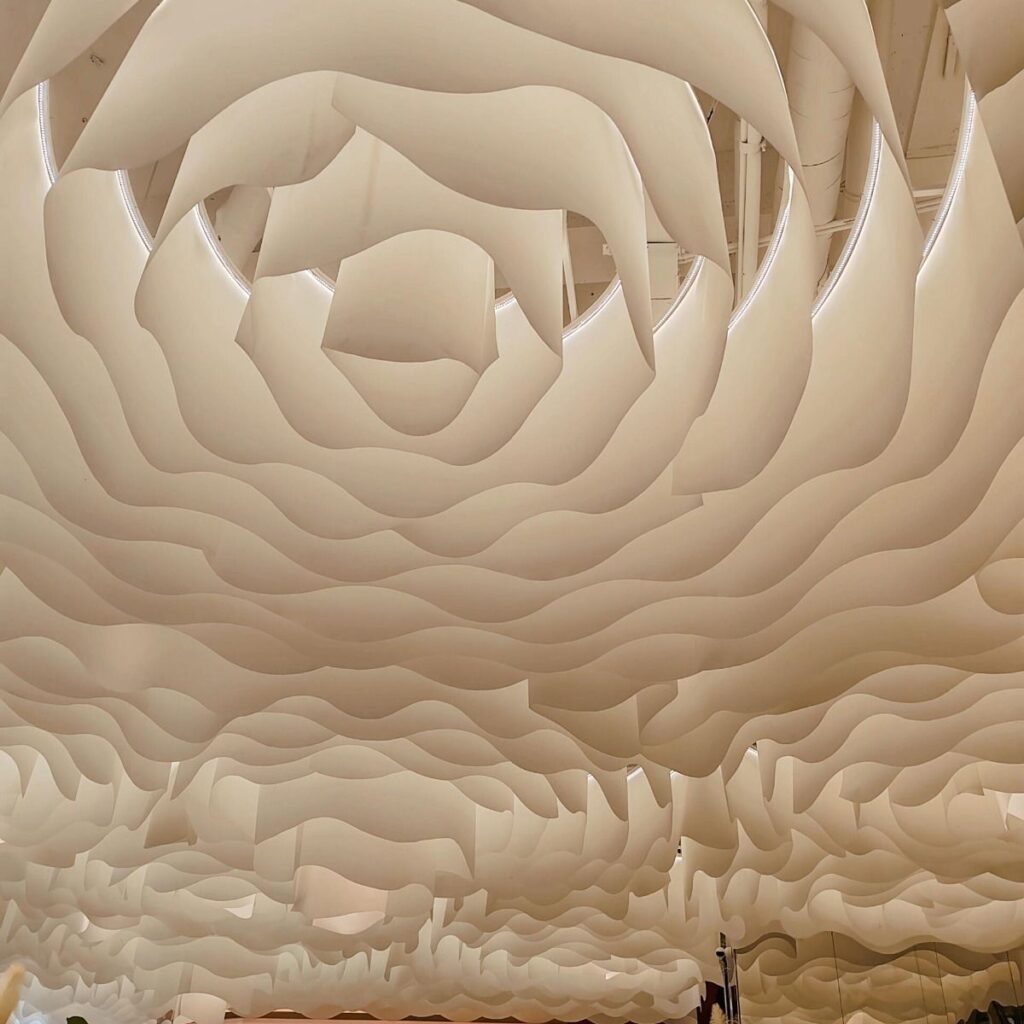
Acoustic fabric ceiling — a breathable textile that is naturally sound-permeable, with a soft matte finish. Proten Fos fabric stretch ceilings and the sculpted Wave Fabric Ceiling fall in this family.
Perforated PVC film — available in matte, satin and even printed finishes, so acoustic performance can be combined with custom graphics like printed stretch ceilings.
Benefits of acoustic stretch ceilings
Hides uneven slabs, cables and ductwork
Integrates lighting, speakers and AC diffusers cleanly
Moisture-resistant options for humid climates like the UAE
Fast, clean installation with little debris
Long lifespan with minimal maintenance
Acoustic ceilings for offices: better focus, better meetings
Acoustic ceilings for offices directly improve productivity by cutting distracting noise and making speech easier to understand. Open-plan layouts, glass meeting rooms and hard finishes all make office noise worse.
Where each acoustic ceiling solution works best in an office:
Office zone
Recommended solution
Open-plan workspace
Felt or suspended acoustic baffles in rows above desks
Meeting and board rooms
Seamless acoustic stretch ceiling or fabric acoustic panels
Reception and lobby
Decorative acoustic baffles as a brand statement
Breakout areas and pantries
Baffle clusters or noise reducing ceiling panels
Call booths and focus rooms
High-NRC acoustic panels on ceiling and walls
A well-planned acoustic ceiling system also supports video calls, as microphones pick up far less echo.
Home theater ceilings: where acoustics meet the wow factor
A dedicated home theater ceiling does two jobs: it makes dialogue and surround sound crisp, and it sets the mood the moment the lights go down. Without acoustic treatment, even premium speakers sound muddy in a room with a hard plaster ceiling.
What makes a great home cinema ceiling
Sound absorption — an acoustic fabric or perforated stretch ceiling controls first reflections and echo.
Hidden speakers — ceiling-mounted Atmos speakers can sit behind a sound-transparent membrane.
Dark, matte finish — stops light from the screen bouncing back into the room.
Integrated lighting — dimmable LED lines, coves and effects built into the ceiling.
The starlight ceiling home theater upgrade
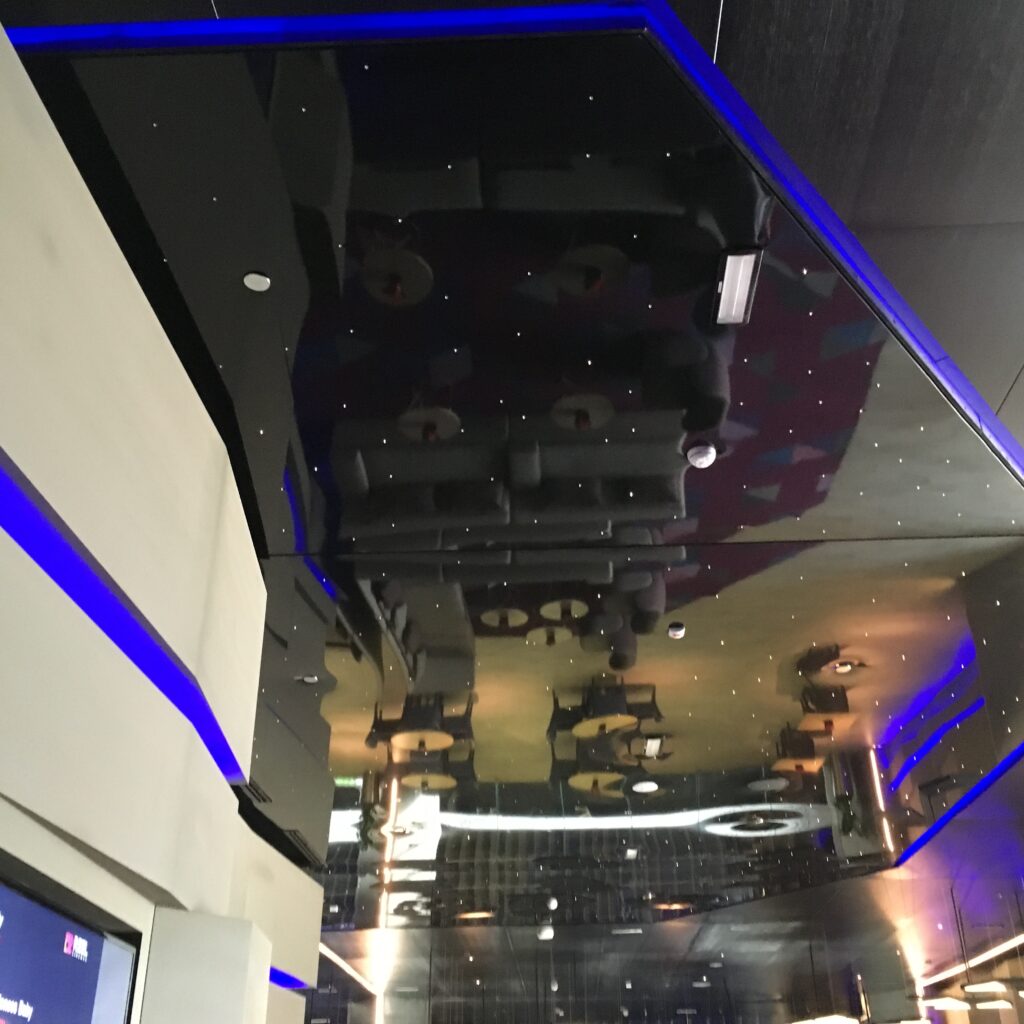
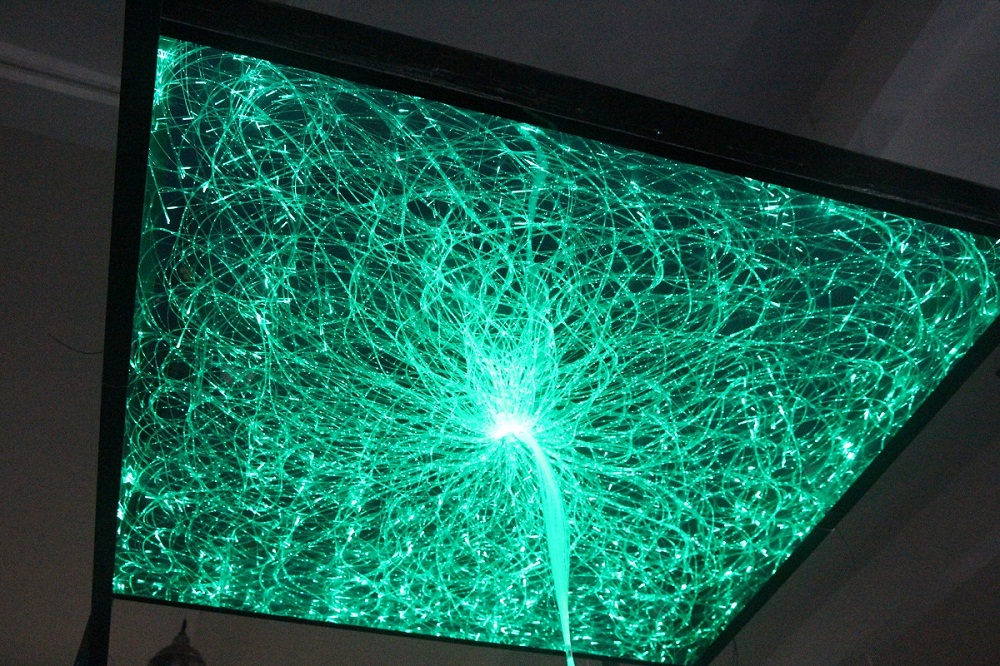
A starlight ceiling home theater adds hundreds of fibre-optic “stars” to a dark stretch ceiling, often with twinkle and shooting-star effects. Paired with an acoustic backing, you get a night-sky feel and a room that sounds as good as it looks. For something more dramatic, 3D stretch ceilings or printed galaxy designs turn your home cinema into a true showpiece.
How to choose acoustic ceiling installers near you
The best acoustic panels only perform if they are designed and installed correctly. When searching for acoustic ceiling installers near me, check for:
Site survey first — a good installer measures the room, checks the slab and asks how the space is used before quoting.
Acoustic planning — they should recommend the right mix of baffles, panels or stretch ceiling, not a one-size-fits-all product.
Portfolio of similar projects — offices, restaurants, villas and home cinemas each have different needs.
Certified, fire-rated materials — ask for fire and safety certificates suitable for UAE regulations.
Lighting and MEP coordination — your installer should work around AC, sprinklers, speakers and lighting.
Warranty and aftercare — look for clear warranty terms on materials and workmanship.
Proten Fos designs and installs stretch and acoustic ceiling systems across the UAE, handling everything from design and 3D visuals to lighting integration and final handover.
Frequently asked questions
What is the difference between acoustic panels and acoustic baffles? Acoustic panels are mounted flat against or just below the ceiling, while acoustic baffles hang vertically. Baffles expose more surface to sound, so they work especially well in high or open ceilings.
Do acoustic stretch ceilings really reduce noise? Yes. A perforated or fabric stretch ceiling with an acoustic layer above it absorbs sound and reduces echo, while keeping a smooth, seamless finish.
Can a starlight ceiling also be acoustic? Yes. Fibre-optic stars can be built into an acoustic stretch ceiling, so your home theater gets both the visual effect and proper sound control.
Are felt acoustic ceiling baffles eco-friendly? Many felt baffles are made from PET, often containing recycled plastic bottles, and are themselves recyclable. Ask your supplier for the recycled content of the specific product.
How long does an acoustic ceiling installation take? Most rooms take one to a few days, depending on size and system. A baffle ceiling or stretch ceiling is usually faster and cleaner than traditional gypsum work.
Ready for a quieter, more beautiful space?
Whether you need acoustic ceilings for offices, a decorative baffle ceiling for your restaurant or a starlight home cinema ceiling, Proten Fos can design the right acoustic solution for your space.
Contact Proten Fos today for a free consultation and site visit with our acoustic ceiling installers.
Explore the top stretch ceilings in UAE and discover modern design trends that elevate interiors with style, innovation, and functional lighting solutions.
Some ceilings blend into the background. Others define the entire room.
A wave fabric ceiling design does the latter. The moment you walk into a space where one has been installed, the overhead surface commands attention in the best possible way: a continuous, flowing form that introduces depth, movement, and architectural character to a room that no flat ceiling can replicate.
In 2026, wave fabric ceiling design has moved well beyond niche luxury projects. Architects are specifying it for corporate headquarters. Hospitality designers are building entire guest experience strategies around it. Homeowners are investing in it for living rooms, bedrooms, and home cinemas. And the reason is straightforward: nothing else delivers the same combination of visual impact, acoustic performance, and long-term practicality in a single ceiling system.
This guide covers everything you need to plan, budget, and execute a wave fabric ceiling design with confidence.
What Exactly Is a Wave Fabric Ceiling Design?
A wave fabric ceiling design is a tensioned textile ceiling system where premium fabric is stretched and fixed over a precision-engineered three-dimensional profile to create a continuous, undulating overhead surface.
The result is not a flat ceiling with decoration applied to it. The wave form is structural and intentional, engineered to a specific amplitude, frequency, and profile before a single piece of fabric is cut or installed.
Three elements work together in every wave fabric ceiling design:
The aluminium track system anchors the installation to the existing ceiling or wall structure, concealing all wiring, supports, and lighting infrastructure behind a completely clean visible surface.
The wave profile framework creates the three-dimensional geometry. This is where the character of the ceiling is determined. The height, depth, and spacing of the waves are all specified at the design stage and fabricated off-site to exact tolerances.
The tensioned fabric membrane is the visible surface. Precision-cut to template and stretched into the profile, it produces the smooth, taut, wrinkle-free wave surface that defines a high-quality installation.
The installation is entirely dry. No plasterwork, no painting, no dust, no weeks of curing time. A typical room is complete in one to three days.
6 Wave Fabric Ceiling Design Ideas That Work in 2026
The flexibility of wave fabric ceiling design is one of its most compelling qualities. Here are six distinct design directions that are performing strongly in 2026 interiors.
1. The Backlit Glow Design
Translucent or semi-translucent fabric is mounted over a concealed LED backlight array, transforming the entire ceiling surface into a softly glowing panel of light. The wave form adds depth to the glow, creating areas of varying intensity that make the ceiling feel alive rather than flat.
This wave fabric ceiling design works particularly well in spas, bedrooms, and high-end hospitality environments where atmosphere is the primary design goal. Color-tunable LED systems allow the mood to shift from warm amber in the evening to cool daylight white during working hours.
2. The Sculptural Monochrome Design
A deep-wave profile in crisp matte white, lit with precision spotlights recessed into the wave troughs. No color, no complexity, no decoration beyond the form itself. This wave fabric ceiling design relies entirely on the interplay of light and shadow across the wave surface to create visual interest.
It is one of the most timeless and architecturally rigorous approaches available and works exceptionally well in contemporary residential spaces, corporate boardrooms, and premium retail environments.
3. The Warm Linen Finish Design
Soft, textured linen-tone fabric in a low-profile wave configuration, lit with warm perimeter cove lighting. This wave fabric ceiling design prioritizes warmth and tactility over drama. The result feels residential, inviting, and crafted without being showy.
This approach suits dining rooms, hotel suites, private members clubs, and any environment where the ceiling should feel considered rather than theatrical.
4. The Fiber Optic Constellation Design
A deep-set wave fabric ceiling design with hundreds of fiber optic points embedded in or behind the fabric surface, creating a star-field effect that shifts and glimmers. This is one of the most consistently requested designs in luxury residential and hospitality projects in 2026.
The wave form adds an extra dimension to the effect: because the fabric surface is not flat, the constellation appears to curve and recede overhead in a way that a flat fiber optic installation cannot replicate.
5. The Brand Color Commercial Design
In retail, hospitality, and corporate environments, a wave fabric ceiling design can be executed in a brand-specific color. Custom-dyed fabric in a precise brand hue, combined with integrated linear lighting along wave crests, creates a ceiling that is as much about brand communication as it is about interior design.
This approach is particularly effective in flagship retail stores, hotel lobbies, and corporate reception areas where the ceiling becomes an active part of the brand experience.
6. The Acoustic Performance Design
Not all wave fabric ceiling design decisions are primarily visual. In offices, restaurants, conference facilities, and educational environments, the primary driver may be acoustic performance. In this case, the fabric specification shifts toward heavyweight acoustic weaves with high sound absorption coefficients, and the wave profile is designed to maximize the total fabric surface area overhead.
The acoustic result is a measurable reduction in reverberation time, echo, and ambient noise levels. In a busy restaurant, this means guests can hold conversations comfortably without raising their voices. In an open-plan office, it means focused work is possible without acoustic fatigue.
Wave Fabric Ceiling Design by Room Type
The same ceiling system performs very differently depending on the room it’s installed in. Here is how wave fabric ceiling design should be approached for the most common applications.
Living Rooms and Open-Plan Spaces
The challenge in open-plan spaces is scale. Large rooms with high ceilings can feel cold, cavernous, and acoustically harsh. A wave fabric ceiling design addresses all three issues: the wave form introduces visual scale and proportion, the fabric absorbs ambient sound, and the integrated lighting creates zones of warmth within the larger space.
For living rooms, a mid-amplitude wave profile with warm-toned fabric and perimeter cove lighting tends to produce the most universally pleasing result.
Master Bedrooms
The bedroom ceiling is statistically the surface most occupants look at most, yet it receives the least design attention in most homes. A wave fabric ceiling design in a master bedroom creates a genuinely restorative environment. Low-amplitude waves in a matte or soft-texture fabric, backlit with warm tunable LEDs, produce an atmosphere that supports relaxation and sleep quality.
The acoustic absorption is an additional benefit: a quieter ceiling contributes to a quieter room, which contributes to better rest.
Hotel Lobbies and Reception Spaces
In hospitality design, the lobby ceiling sets the tone for the entire guest experience. A dramatic wave fabric ceiling design in a hotel lobby communicates investment, creativity, and quality within seconds of a guest entering the space. With multi-layer lighting integration including spotlights, linear strips, and color-changing capability, the ceiling can present an entirely different character for check-in, evening cocktails, and special events.
Restaurants and Dining Environments
Two things determine how long guests stay and how much they spend in a restaurant: the food and the atmosphere. A wave fabric ceiling design contributes directly to both. The acoustic performance reduces noise levels, making dining more comfortable and conversation easier. The visual warmth and intimacy created by a well-designed fabric ceiling with appropriate lighting encourages guests to relax, order more, and return.
Corporate Offices and Boardrooms
A wave fabric ceiling design in a corporate environment signals design intelligence and organizational quality. In boardrooms specifically, the acoustic clarity improvement makes presentations cleaner, conference calls more audible, and negotiations less exhausting. The ceiling works quietly in the background, improving the performance of the space without drawing attention to itself.
Retail Showrooms and Flagship Stores
In premium retail, every surface contributes to the perceived value of the products on display. A wave fabric ceiling design raises the quality ceiling of the entire shopping environment, creating a context in which luxury products feel at home. With integrated spotlighting directing precise pools of light onto key merchandise areas, the ceiling also functions as a sophisticated lighting tool.
Wave Fabric Ceiling Design Cost: What You Need to Know in 2026
Wave fabric ceiling design sits at the premium end of the ceiling market, and pricing reflects the quality of materials, the precision of fabrication, and the expertise required for installation. Understanding the cost drivers helps you plan your budget accurately and evaluate quotes fairly.
Primary Cost Factors
Ceiling area is the dominant cost variable. Pricing is calculated per square metre, and larger installations benefit from economies of scale in fabrication and installation.
Wave profile complexity affects both fabrication time and installation time. A straightforward repeating wave across a rectangular space is significantly faster to engineer and install than a multi-directional or asymmetric wave design.
Fabric specification varies in cost depending on the performance requirements. Standard matte or textured fabric is the most cost-effective option. Specialist acoustic weaves, translucent backlighting fabrics, and custom-dyed color options carry a material premium that is typically worth the investment for the right application.
Lighting integration is often where the most significant additional cost sits and also where the most significant additional impact is created. Integrated backlighting, recessed spotlights, fiber optic systems, and RGB color-changing all require additional materials, labor, and coordination between the ceiling installation and the electrical infrastructure.
Site conditions including ceiling height, access requirements, structural complexity, and whether the project is new-build or retrofit, all affect the total installation cost.
Is It Worth the Investment?
For the spaces where a wave fabric ceiling design is the right solution, the answer is consistently yes. The finish does not date quickly. The acoustic benefits are functional and ongoing. The material performance in terms of moisture resistance, UV stability, and dust resistance means that maintenance costs over the lifespan of the installation are minimal. And the transformation in how a space is perceived by everyone who enters it is immediate and lasting.
Common Mistakes in Wave Fabric Ceiling Design (and How to Avoid Them)
Even experienced interior designers occasionally encounter issues with wave fabric ceiling projects. These are the most common mistakes and how to avoid them.
Underestimating the ceiling height requirement. A bold wave profile in a room with a low ceiling will feel oppressive rather than sculptural. As a general principle, allow a minimum of 300mm of vertical clearance for the wave profile plus any integrated lighting infrastructure. Rooms with ceilings below 2.7m should use low-amplitude wave profiles.
Making lighting decisions too late. Lighting infrastructure must be integrated during installation. Retrofitting lighting into an installed wave fabric ceiling is significantly more disruptive and costly than planning for it from the outset. Finalize lighting requirements before installation begins.
Choosing a supplier who outsources fabrication. The quality of a wave fabric ceiling design is determined in the fabrication phase. If a supplier is outsourcing fabric cutting and profile manufacturing to a third party, they have limited quality control over the most critical stages of the project. Always verify that design, fabrication, and installation are managed in-house.
Specifying the wrong fabric for the environment. In high-humidity environments, moisture-resistant fabric specification is non-negotiable. In high-UV environments, UV-stable materials prevent premature fading. Always request and verify material certification before signing off on a specification.
Treating the ceiling design in isolation. The most successful wave fabric ceiling design projects are those where the ceiling has been considered as part of the overall interior scheme from the beginning. Wave amplitude, fabric color, and lighting configuration should all be designed in relation to the walls, flooring, furniture, and natural light conditions of the specific space.
Wave Fabric Ceiling Design vs Other Premium Ceiling Options
Feature
Wave Fabric Ceiling Design
Coffered Plaster Ceiling
Acoustic Tile Ceiling
Standard Stretch Ceiling
Installation Time
1 to 3 days
Weeks
1 to 2 days
1 to 2 days
Acoustic Performance
Excellent
Poor
Good
Moderate
Visual Impact
Very High
High
Low
Moderate
Lighting Integration
Full range
Limited
Limited
Full range
Moisture Resistance
High
Low
Moderate
High
Reversibility
Yes
No
Yes
Yes
Maintenance
Minimal
Periodic repainting
Periodic tile replacement
Minimal
Best Application
Luxury, hospitality, statement spaces
Traditional, heritage, formal
Commercial budget projects
Modern minimalist interiors
7 Questions to Ask Before Commissioning a Wave Fabric Ceiling Design
Before committing to a supplier or signing a contract, these seven questions will help you identify genuine specialists from generalist contractors.
1. Do you handle design, fabrication, and installation under one roof? The answer should be yes. End-to-end control is the single biggest quality assurance factor in wave fabric ceiling design.
2. Can you share completed projects in environments similar to mine? Ask specifically for references in your type of space: residential, hospitality, corporate, or retail.
3. What fabric specifications do you use and can you provide material certification? Fire rating, acoustic performance data, moisture resistance, and UV stability should all be documented and verifiable.
4. How is lighting integration managed? Is it coordinated by your team or handed off to a separate electrical contractor? Integrated coordination produces better outcomes.
5. What is your warranty and what does it cover specifically? A confident specialist backs their work with a clear, written warranty.
6. What does post-installation support look like? Understand the process before you need it.
7. How do you handle changes or additions after the installation is complete? Fabric panels can typically be replaced or updated independently of the track and profile system, but the process and cost should be understood upfront.
FAQs: Wave Fabric Ceiling Design
Can a wave fabric ceiling design be installed in a room with an existing ceiling? Yes. The mounting track system fixes to the existing structure without requiring removal of the existing ceiling in most cases. This makes wave fabric ceiling design particularly practical for renovation projects.
How long does installation take? A single residential room typically takes one to three days. Larger commercial installations are planned and phased to minimize disruption to operations.
Is wave fabric ceiling design suitable for humid environments like bathrooms? Yes, provided the correct moisture-resistant fabric specification is used. Material selection must match the environmental conditions of the specific room.
Can I update the fabric color or finish in the future without replacing the whole system? Yes. One of the practical advantages of tensioned fabric ceiling systems is that the fabric membrane can be replaced independently of the aluminium track and wave profile structure, at a fraction of the cost of a full reinstallation.
Does a wave fabric ceiling design affect air conditioning or ventilation? The installation is designed to work with existing HVAC systems. Air outlets and returns can be integrated into the ceiling design without compromising either the fabric surface or the ventilation performance.
How do I maintain a wave fabric ceiling? Routine maintenance requires nothing more than a soft dry cloth or low-power vacuum attachment for occasional dust removal. The fabric surface is not designed for wet chemical cleaning.
The Bottom Line
A wave fabric ceiling design is not a decorative choice. It is an architectural one.
It changes how a room sounds. It changes how a room feels. It changes how every person who enters that room perceives the quality and intentionality of the space they are standing in.
In 2026, as interior design continues to move toward spaces that perform as well as they look, a wave fabric ceiling design sits at exactly the intersection of form and function that the best projects demand.
If you are ready to explore what this ceiling system could do for your specific space, the next step is a conversation with a specialist who has the experience and the in-house capability to bring your vision to life.
Get in touch with our team today for a free design consultation and project quote.
Stretch fabric panels have revolutionized modern interior design — but the real magic lies in what’s behind them. The right lighting can turn a plain fabric installation into a breathtaking focal point, a functional workspace illuminator, or an immersive atmospheric experience. Choosing the right lights for stretch fabric panels is the single most important decision in any fabric installation project. The light source you select determines brightness uniformity, color accuracy, energy efficiency, and the overall mood of your space.
Whether you’re a designer, contractor, or homeowner, choosing the correct light source is critical to getting the most out of your stretch fabric system. In this guide, we break down the 10 most effective types of lights for stretch fabric panels, their benefits, and which spaces they suit best.
Why Choosing the Right Lights for Stretch Fabric Panels Matters
Not all lights work equally well behind stretch fabric. The wrong choice leads to hot spots, uneven glow, color distortion, or heat damage to the fabric. The right lighting delivers seamless, edge-to-edge illumination that enhances any space beautifully.
Let’s explore your options.
1. Single-Color LED Lights
Single-color LEDs are the most widely used lighting solution for stretch fabric panels — and for good reason. They deliver consistent, uniform light in a fixed tone such as warm white (2700K), cool white (5000K), or accent colors like blue or red. Single-color LEDs are the most popular lights for stretch fabric panels due to their simplicity, low cost, and reliable performance.
Key Benefits:
Budget-friendly and cost-effective
Extremely energy-efficient with low electricity costs
Long lifespan of 25,000–50,000 hours with minimal maintenance
Best For: Spas, hotel lobbies, bedrooms, and any space requiring a consistent, calm ambiance.
2. Tunable White LED Lights
Tunable white LEDs go a step further by allowing users to adjust the color temperature anywhere from warm amber (2700K) to crisp daylight blue (6500K). This flexibility makes them one of the most versatile lighting options available.
Key Benefits:
Adaptable to different moods and activities throughout the day
Boosts productivity with cool tones in work settings
Creates a cozy atmosphere with warm tones in relaxation spaces
Best For: Offices, retail stores, modern homes, and hospitality environments.
3. RGB LED Lights
RGB LEDs combine red, green, and blue diodes to produce virtually any color in the visible spectrum. This makes them a top choice for dynamic, eye-catching lighting effects behind stretch fabric panels.
Key Benefits:
Millions of color combinations for fully customizable displays
Programmable effects including fading, strobing, and color cycling
Energy-efficient despite their wide range of capabilities
Best For: Bars, nightclubs, gaming rooms, event spaces, and creative residential interiors.
4. RGBW LED Lights
RGBW lights build on standard RGB technology by adding a dedicated white diode. This seemingly small addition makes a significant difference in light quality and versatility.
Key Benefits:
Produces a true, balanced white light — not achievable with RGB alone
Enhances color vibrancy and saturation
Functions as both decorative and functional lighting in one system
Best For: Luxury retail spaces, high-end residential projects, and architectural feature lighting.
5. Dynamic White LED Lights
Dynamic white LEDs offer smooth, automated transitions across multiple white tones, mimicking the natural shift of daylight from morning to evening. This makes them especially valuable in health and wellness applications.
Key Benefits:
Simulates natural daylight cycles for a more human-centric environment
Supports circadian rhythm regulation, improving sleep and focus
Integrates seamlessly with stretch fabric for sophisticated, subtle effects
Best For: Hospitals, healthcare facilities, offices, and upscale hospitality settings.
6. Edge-Lit LED Panels
Edge-lit LED panels emit light from the panel’s perimeter, allowing it to spread evenly across the entire fabric surface. They’re a sleek, modern solution for clean and minimalist interiors. These panels are among the most efficient lights for stretch fabric panels, offering flawless uniformity with a slim, low-profile design.
Key Benefits:
Delivers shadow-free, uniform illumination across large surfaces
Ultra-slim profile ideal for low-clearance or minimalist installations
High energy efficiency with impressive light output
Best For: Conference rooms, corporate showrooms, and commercial display environments.
7. Backlit LED Grids
Backlit LED grids use an array of LEDs mounted in a structured grid directly behind the stretch fabric. This approach ensures even brightness across every inch of the installation, making it ideal for large-format applications.
Key Benefits:
Consistent, uniform brightness across large-scale surfaces
Fully customizable to any shape, size, or layout
Makes printed fabric graphics — logos, images, patterns — vivid and impactful
Best For: Retail displays, trade show booths, airport signage, and large-format art installations.
8. Fiber Optic Lighting
Fiber optic lighting is the creative choice for truly unique stretch fabric installations. Light is transmitted through thin optical fibers, producing starry or scattered point-light effects that are impossible to replicate with standard LEDs.
Key Benefits:
Emits virtually no heat, making it safe for heat-sensitive environments
Enables intricate custom patterns — stars, constellations, and bespoke designs
Extremely durable with a long operational life
Best For: Home theater ceilings, luxury spas, children’s rooms, and premium hospitality venues.
9. Neon-Style LED Strips
Neon-style LED strips replicate the warm, glowing aesthetic of classic neon signs but with all the advantages of modern LED technology. They’re flexible, durable, and far more energy-efficient than traditional neon.
Key Benefits:
Flexible enough to be shaped into letters, logos, or custom designs
Significantly more durable and shatter-resistant than glass neon tubes
Low energy consumption with long-lasting performance
Best For: Commercial signage, artistic installations, retail accent lighting, and contemporary interior feature walls.
10. Smart LED Lighting Systems
Smart LED systems represent the future of stretch fabric lighting. With Wi-Fi, Bluetooth, or Zigbee connectivity, these systems integrate with apps, voice assistants, and home automation platforms for fully automated, intelligent control.
Key Benefits:
Control lighting remotely via smartphone apps or voice commands (Alexa, Google Home)
Create and save custom scenes for different moods or activities
Reduce energy costs through automated schedules and motion-based activation
Best For: Smart homes, forward-thinking commercial spaces, and any installation where long-term convenience and energy savings matter.
Best Lights for Stretch Fabric Panels: Quick Comparison
Lighting Type
Best Use Case
Color Options
Energy Efficiency
Single-Color LED
Spas, lobbies
Fixed
⭐⭐⭐⭐⭐
Tunable White LED
Offices, homes
White range
⭐⭐⭐⭐⭐
RGB LED
Bars, events
Full spectrum
⭐⭐⭐⭐
RGBW LED
Luxury spaces
Full + true white
⭐⭐⭐⭐
Dynamic White LED
Healthcare, hospitality
White range
⭐⭐⭐⭐⭐
Edge-Lit Panels
Corporate, showrooms
Depends on LED
⭐⭐⭐⭐⭐
Backlit LED Grids
Retail, exhibitions
Depends on LED
⭐⭐⭐⭐
Fiber Optic
Theaters, spas
White/custom
⭐⭐⭐⭐
Neon-Style LED
Signage, accents
Fixed/limited
⭐⭐⭐⭐
Smart LED
Smart homes, offices
Full spectrum
⭐⭐⭐⭐⭐
FAQs About Lights for Stretch Fabric Panels
Can stretch fabric panels work with my existing lighting?
Yes, in most cases. You’ll need to verify that your existing system distributes light evenly and that the fabric material diffuses light effectively to prevent hot spots or shadows.
How long do LED lights behind stretch fabric last?
Quality LED lights typically last between 25,000 and 50,000 hours. Proper installation and regular maintenance will help you reach the upper end of that range.
Can I change the color of lights behind my stretch fabric panels?
If you install RGB or RGBW LEDs, yes — you can change colors freely via remote controls, apps, or smart home systems. Tunable white LEDs allow temperature adjustments but stay within the white spectrum.
Will the lights heat up and damage the fabric?
Modern LEDs emit very little heat, making them safe for use behind stretch fabric. That said, proper ventilation is still recommended — especially in enclosed installations.
Can I dim the lights?
Yes. Most LED systems are dimmable, allowing you to fine-tune brightness based on the time of day, mood, or function of the space.
Are stretch fabric lighting systems customizable?
Absolutely. From fabric color and texture to lighting type and effect, stretch fabric lighting systems are highly customizable to match any design vision.
Find the Best Types of Lights for Stretch Fabric Panels
The combination of stretch fabric and strategic lighting opens up extraordinary design possibilities. Whether you’re drawn to the simplicity of single-color LEDs, the flexibility of tunable whites, the drama of RGB displays, or the intelligence of smart lighting systems, there’s a perfect solution for every space and budget.
No matter your budget or design goal, the best lights for stretch fabric panels are the ones that balance aesthetics, function, and energy efficiency for your specific space.
Ready to transform your space with a stretch fabric lighting installation? Contact us today and let our experts design the ideal lighting solution for your project.
Wave fabric ceilings are redefining luxury interiors across Dubai and the UAE. This in-depth guide explains what a wave fabric ceiling is, how the system works, design and lighting possibilities, key benefits over standard stretch ceilings, and why Proten Fos is the trusted partner for high-end villas, hotels, restaurants, and commercial projects
Dubai’s interior design landscape is constantly evolving. From luxury villas to high-end retail spaces and corporate offices, ceiling design plays a major role in defining ambiance and visual impact. One solution that continues to gain popularity across the city is the stretch ceiling in Dubai.
With options like illuminated ceilings, printed designs, mirror finishes, 3D structures, and fabric systems, stretch ceilings offer unmatched flexibility for both residential and commercial interiors.
In this article, we explore the different types, advantages, and applications of stretch ceilings across Dubai.
Why Stretch Ceilings Are Ideal for Dubai Properties
Dubai’s climate and architectural standards demand materials that combine durability with premium aesthetics. Stretch ceiling systems meet these expectations effectively.
1. Heat & Humidity Resistance
Dubai’s high temperatures and humidity levels require materials that remain stable over time. Stretch ceilings are designed to perform well in such conditions.
2. Waterproof & Mold Resistant
PVC-based systems are waterproof, making them suitable for kitchens, bathrooms, and commercial environments.
3. Fire-Resistant & Safe
Quality stretch ceiling materials meet international safety standards and are manufactured using fire-retardant components.
4. Fast & Clean Installation
Most stretch ceiling installation projects in Dubai are completed within one to two days, with minimal disruption to the property.
5. Long-Term Durability
These ceilings require very little maintenance and maintain their appearance for years.
For property owners seeking modern ceiling solutions in Dubai, stretch ceilings offer both practicality and elegance.
Popular Types of Stretch Ceilings in Dubai
One of the biggest advantages of stretch ceilings is design versatility. Here are the most popular options available in Dubai.
Illuminated Ceilings
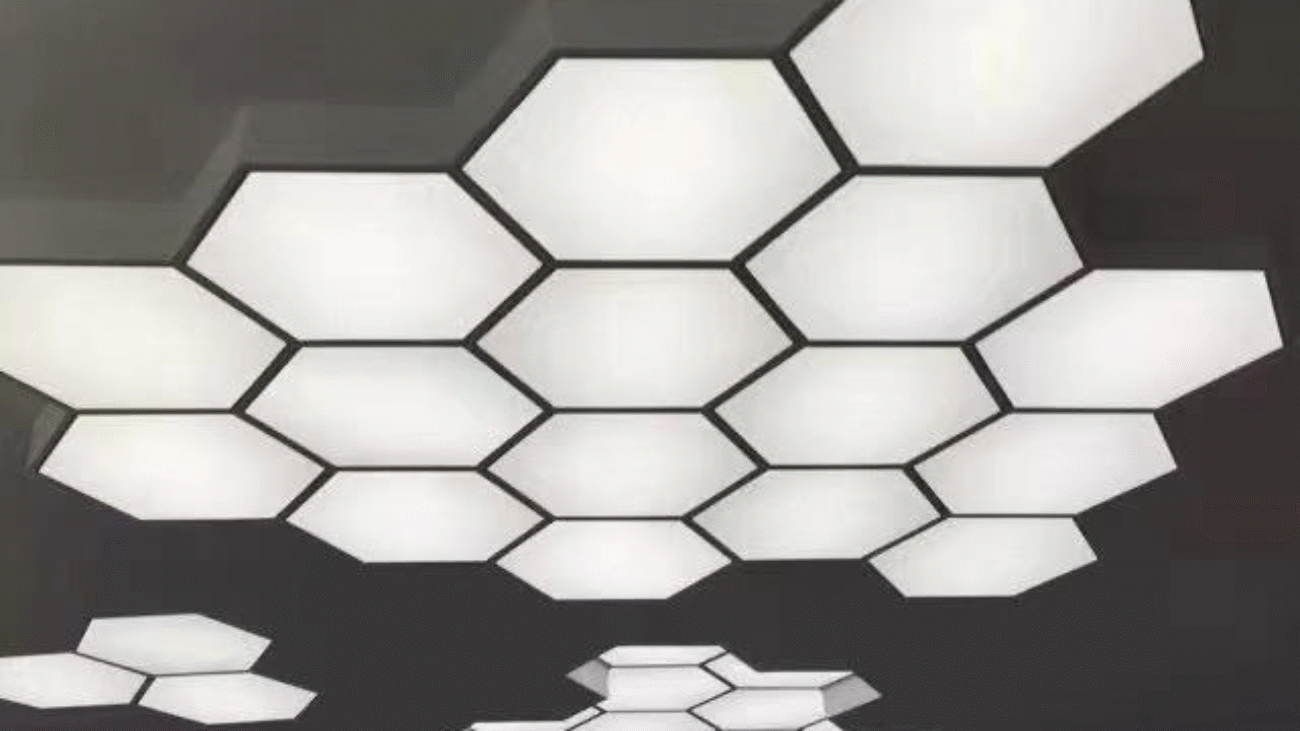
Illuminated ceilings integrate LED lighting behind a translucent membrane, creating a soft, evenly diffused glow across the entire surface.
Ideal Applications:
Living rooms
Bedrooms
Hotel lobbies
Restaurants
Offices
Retail stores
This ceiling style enhances ambiance and provides uniform lighting without visible fixtures. Illuminated stretch ceilings are especially popular in luxury villas and hospitality projects in Dubai.
Printed Stretch Ceilings
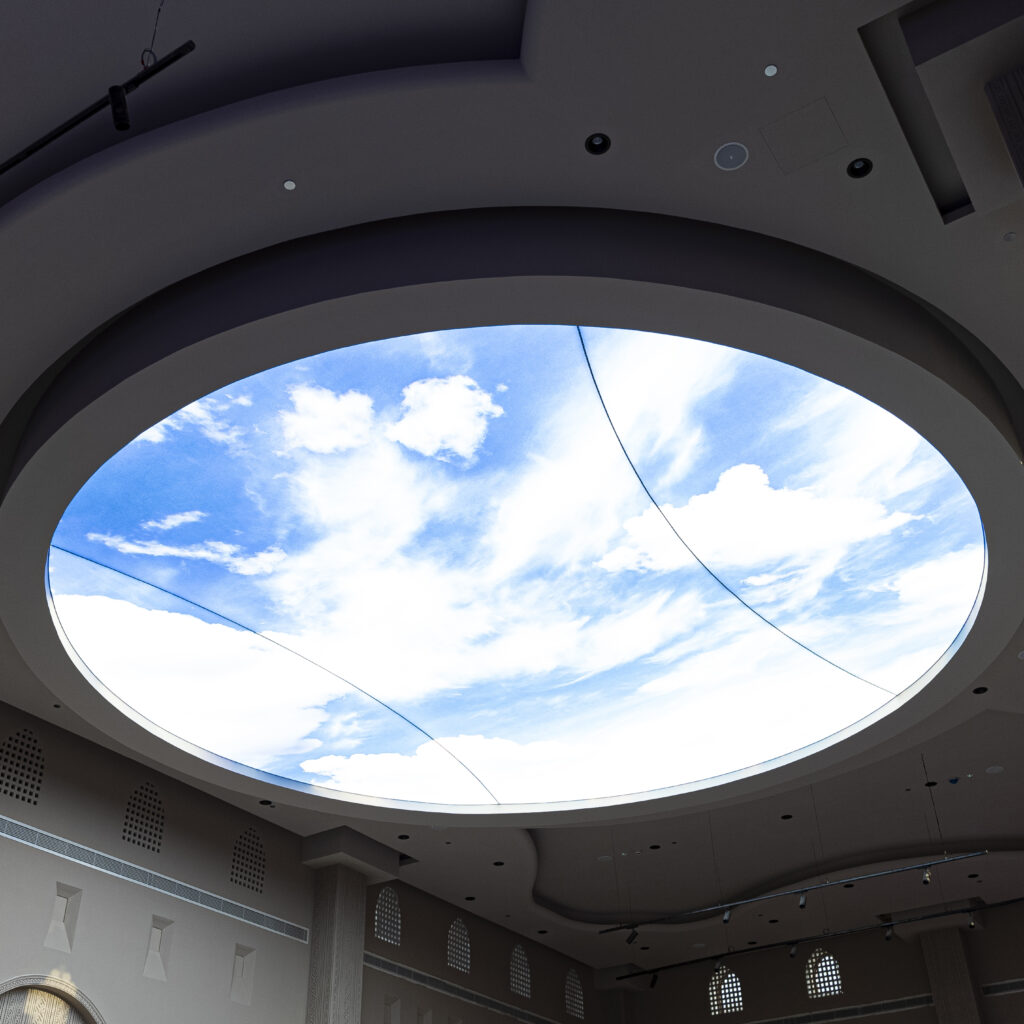
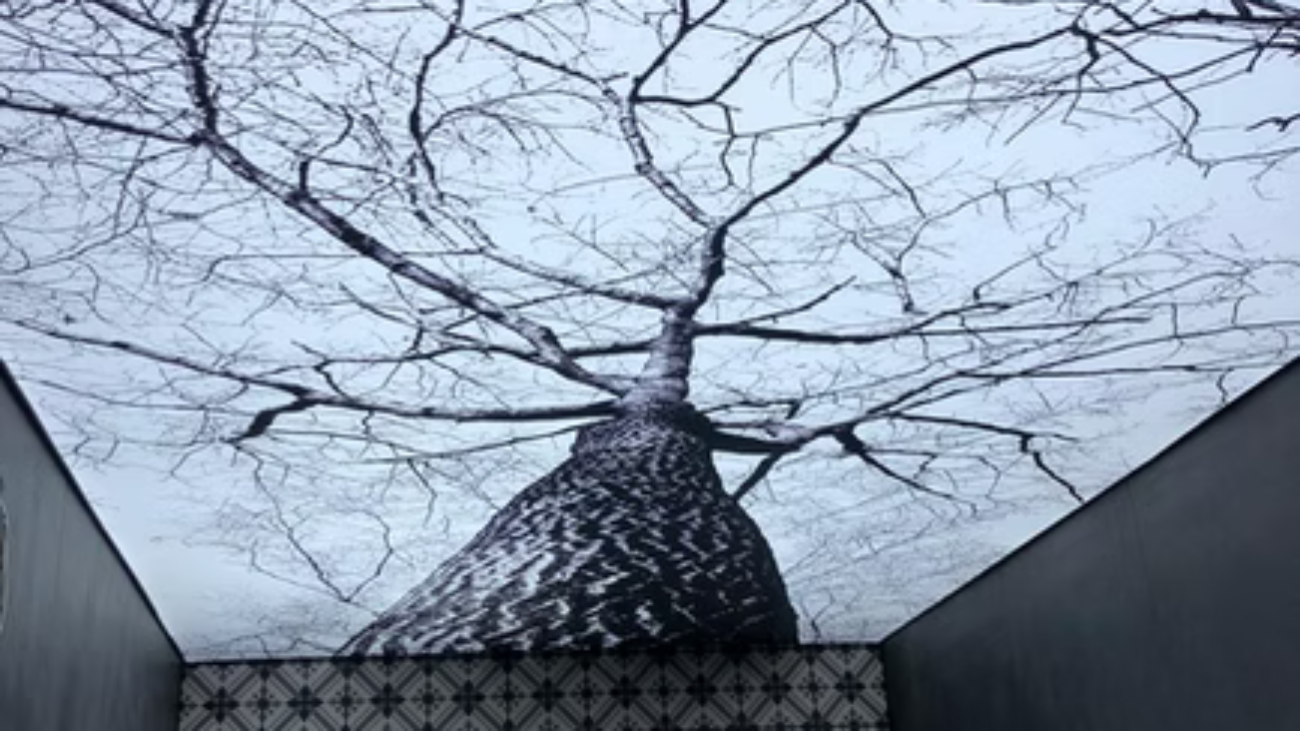
Printed stretch ceilings allow custom graphics and high-resolution visuals to be incorporated directly into the ceiling design.
Popular Uses:
Kids’ rooms
Themed restaurants
Clinics and wellness centers
Retail branding spaces
Corporate offices
From sky effects to custom artwork or brand visuals, printed ceilings offer creative freedom while maintaining a sleek finish.
Mirror Ceilings
Mirror stretch ceilings feature a glossy, reflective surface that enhances brightness and creates an illusion of expanded space.
Best Suited For:
Luxury villas
Boutiques
Showrooms
Salons
Reception areas
In Dubai’s premium interiors, mirror ceilings are often selected to create a sophisticated and contemporary look.
3D Stretch Ceilings
3D stretch ceilings introduce sculptural and layered designs that add depth and architectural character to a space.
Key Features:
Curved or wave structures
Multi-level designs
Integrated lighting
Customized shapes
These ceilings are ideal for high-end residential projects, hotels, restaurants, and commercial spaces looking to create a strong visual statement.
Fabric Stretch Ceilings
Fabric stretch ceilings offer a seamless and refined appearance. They are particularly beneficial for large spaces where a smooth, joint-free finish is required.
Advantages:
Seamless surface
Acoustic improvement
Eco-friendly material options
Suitable for large-span areas
Fabric ceilings are commonly used in offices, meeting rooms, auditoriums, and residential interiors where both aesthetics and sound control matter.
Residential Applications of Stretch Ceilings in Dubai
Stretch ceiling installation in Dubai has become increasingly popular in residential projects due to its flexibility and minimal renovation requirements.
Common Residential Spaces:
Living rooms
Bedrooms
Kitchens
Bathrooms
Home theaters
Villas and apartments
Homeowners appreciate the ability to modernize their ceilings quickly without extensive structural modifications.
Commercial Applications Across Dubai
In commercial settings, ceiling design contributes significantly to branding and customer experience. Stretch ceilings are widely used in:
Corporate offices
Hotels
Restaurants
Retail stores
Clinics
Showrooms
Gyms and salons
Commercial stretch ceiling systems enhance lighting design, improve ambiance, and help businesses create a memorable interior environment.
The Installation Process in Dubai Projects
Understanding the general process helps property owners plan effectively.
1. Site Assessment
Measurements and project requirements are evaluated.
2. Design Finalization
Material type, finish, and lighting integration are selected.
3. Fabrication
The ceiling membrane is prepared according to exact specifications.
4. Professional Installation
The system is carefully installed using perimeter tracks.
5. Final Inspection
Quality checks ensure flawless finishing and alignment.
Because the process is efficient and clean, stretch ceilings are suitable for both new constructions and renovation projects in Dubai.
Cost Considerations for Stretch Ceiling in Dubai
The price of a stretch ceiling installation depends on several factors:
Total ceiling area
Type of material (PVC or fabric)
Lighting integration requirements
Design complexity
3D or multi-level structures
Custom printing
Each project is unique, so pricing varies accordingly. A professional consultation is recommended to receive an accurate estimate.
Final Thoughts
Ceiling design has become an essential element of modern interior architecture in Dubai. Whether you prefer illuminated ceilings for ambient lighting, printed designs for personalization, mirror finishes for luxury appeal, 3D structures for bold architectural impact, or fabric ceilings for seamless elegance, stretch ceiling systems provide a versatile solution.
Choosing a stretch ceiling in Dubai allows property owners to combine durability, style, and efficient installation — making it one of the most innovative ceiling solutions available today.
Stretch Ceiling Myths: 5 Facts Homeowners Need to Know
Worried about PVC safety or easy damage in stretch ceilings? This guide busts myths on durability, color retention, maintenance, and more for confident renovations.
Stretch ceilings for restaurants are redefining modern dining spaces by improving acoustics, integrating lighting, reducing maintenance and enhancing ambiance. Learn how these innovative ceilings help UAE restaurants create memorable guest experiences and smarter, future-ready interiors