
Some ceilings blend into the background. Others define the entire room.
A wave fabric ceiling design does the latter. The moment you walk into a space where one has been installed, the overhead surface commands attention in the best possible way: a continuous, flowing form that introduces depth, movement, and architectural character to a room that no flat ceiling can replicate.
In 2026, wave fabric ceiling design has moved well beyond niche luxury projects. Architects are specifying it for corporate headquarters. Hospitality designers are building entire guest experience strategies around it. Homeowners are investing in it for living rooms, bedrooms, and home cinemas. And the reason is straightforward: nothing else delivers the same combination of visual impact, acoustic performance, and long-term practicality in a single ceiling system.
This guide covers everything you need to plan, budget, and execute a wave fabric ceiling design with confidence.
What Exactly Is a Wave Fabric Ceiling Design?
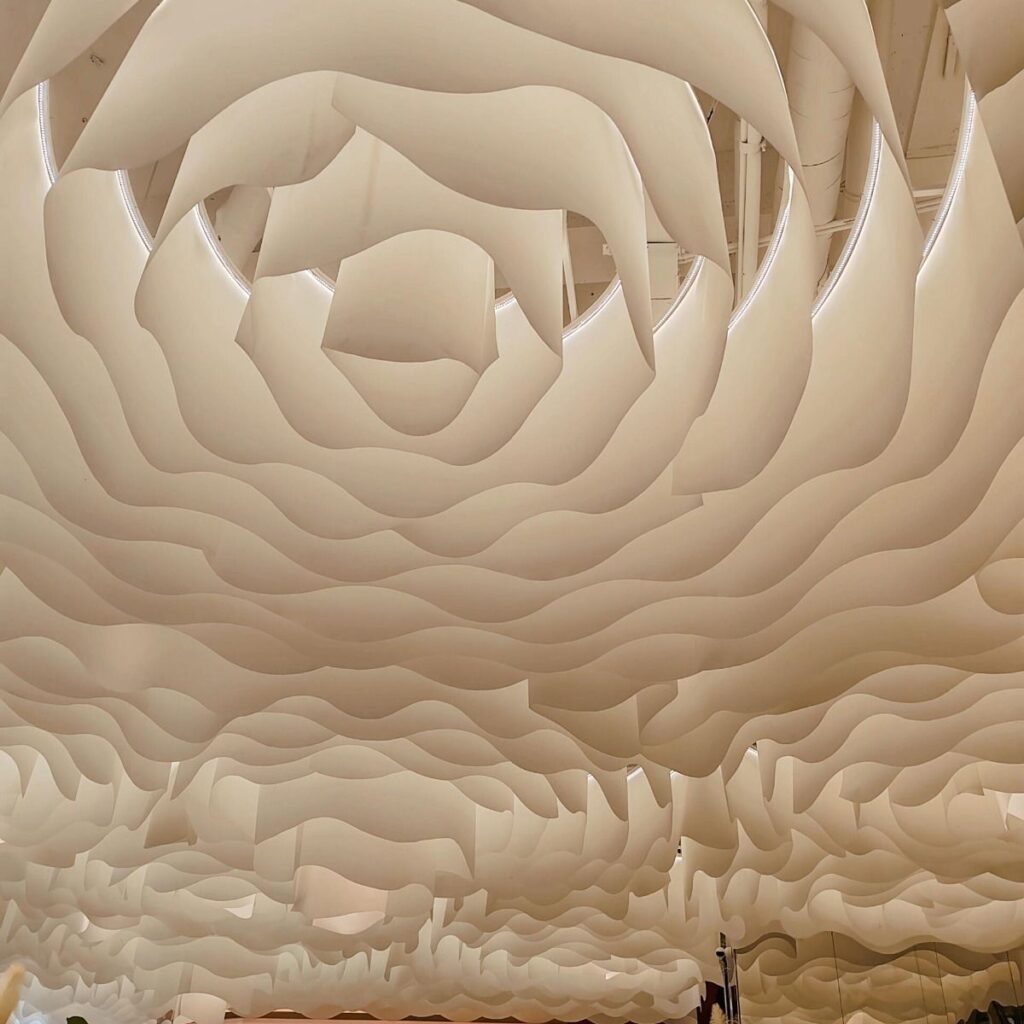
A wave fabric ceiling design is a tensioned textile ceiling system where premium fabric is stretched and fixed over a precision-engineered three-dimensional profile to create a continuous, undulating overhead surface.
The result is not a flat ceiling with decoration applied to it. The wave form is structural and intentional, engineered to a specific amplitude, frequency, and profile before a single piece of fabric is cut or installed.
Three elements work together in every wave fabric ceiling design:
The aluminium track system anchors the installation to the existing ceiling or wall structure, concealing all wiring, supports, and lighting infrastructure behind a completely clean visible surface.
The wave profile framework creates the three-dimensional geometry. This is where the character of the ceiling is determined. The height, depth, and spacing of the waves are all specified at the design stage and fabricated off-site to exact tolerances.
The tensioned fabric membrane is the visible surface. Precision-cut to template and stretched into the profile, it produces the smooth, taut, wrinkle-free wave surface that defines a high-quality installation.
The installation is entirely dry. No plasterwork, no painting, no dust, no weeks of curing time. A typical room is complete in one to three days.
6 Wave Fabric Ceiling Design Ideas That Work in 2026
The flexibility of wave fabric ceiling design is one of its most compelling qualities. Here are six distinct design directions that are performing strongly in 2026 interiors.
1. The Backlit Glow Design
Translucent or semi-translucent fabric is mounted over a concealed LED backlight array, transforming the entire ceiling surface into a softly glowing panel of light. The wave form adds depth to the glow, creating areas of varying intensity that make the ceiling feel alive rather than flat.
This wave fabric ceiling design works particularly well in spas, bedrooms, and high-end hospitality environments where atmosphere is the primary design goal. Color-tunable LED systems allow the mood to shift from warm amber in the evening to cool daylight white during working hours.
2. The Sculptural Monochrome Design
A deep-wave profile in crisp matte white, lit with precision spotlights recessed into the wave troughs. No color, no complexity, no decoration beyond the form itself. This wave fabric ceiling design relies entirely on the interplay of light and shadow across the wave surface to create visual interest.
It is one of the most timeless and architecturally rigorous approaches available and works exceptionally well in contemporary residential spaces, corporate boardrooms, and premium retail environments.
3. The Warm Linen Finish Design
Soft, textured linen-tone fabric in a low-profile wave configuration, lit with warm perimeter cove lighting. This wave fabric ceiling design prioritizes warmth and tactility over drama. The result feels residential, inviting, and crafted without being showy.
This approach suits dining rooms, hotel suites, private members clubs, and any environment where the ceiling should feel considered rather than theatrical.
4. The Fiber Optic Constellation Design
A deep-set wave fabric ceiling design with hundreds of fiber optic points embedded in or behind the fabric surface, creating a star-field effect that shifts and glimmers. This is one of the most consistently requested designs in luxury residential and hospitality projects in 2026.
The wave form adds an extra dimension to the effect: because the fabric surface is not flat, the constellation appears to curve and recede overhead in a way that a flat fiber optic installation cannot replicate.
5. The Brand Color Commercial Design
In retail, hospitality, and corporate environments, a wave fabric ceiling design can be executed in a brand-specific color. Custom-dyed fabric in a precise brand hue, combined with integrated linear lighting along wave crests, creates a ceiling that is as much about brand communication as it is about interior design.
This approach is particularly effective in flagship retail stores, hotel lobbies, and corporate reception areas where the ceiling becomes an active part of the brand experience.
6. The Acoustic Performance Design
Not all wave fabric ceiling design decisions are primarily visual. In offices, restaurants, conference facilities, and educational environments, the primary driver may be acoustic performance. In this case, the fabric specification shifts toward heavyweight acoustic weaves with high sound absorption coefficients, and the wave profile is designed to maximize the total fabric surface area overhead.
The acoustic result is a measurable reduction in reverberation time, echo, and ambient noise levels. In a busy restaurant, this means guests can hold conversations comfortably without raising their voices. In an open-plan office, it means focused work is possible without acoustic fatigue.
Wave Fabric Ceiling Design by Room Type
The same ceiling system performs very differently depending on the room it’s installed in. Here is how wave fabric ceiling design should be approached for the most common applications.
Living Rooms and Open-Plan Spaces
The challenge in open-plan spaces is scale. Large rooms with high ceilings can feel cold, cavernous, and acoustically harsh. A wave fabric ceiling design addresses all three issues: the wave form introduces visual scale and proportion, the fabric absorbs ambient sound, and the integrated lighting creates zones of warmth within the larger space.
For living rooms, a mid-amplitude wave profile with warm-toned fabric and perimeter cove lighting tends to produce the most universally pleasing result.
Master Bedrooms
The bedroom ceiling is statistically the surface most occupants look at most, yet it receives the least design attention in most homes. A wave fabric ceiling design in a master bedroom creates a genuinely restorative environment. Low-amplitude waves in a matte or soft-texture fabric, backlit with warm tunable LEDs, produce an atmosphere that supports relaxation and sleep quality.
The acoustic absorption is an additional benefit: a quieter ceiling contributes to a quieter room, which contributes to better rest.
Hotel Lobbies and Reception Spaces
In hospitality design, the lobby ceiling sets the tone for the entire guest experience. A dramatic wave fabric ceiling design in a hotel lobby communicates investment, creativity, and quality within seconds of a guest entering the space. With multi-layer lighting integration including spotlights, linear strips, and color-changing capability, the ceiling can present an entirely different character for check-in, evening cocktails, and special events.
Restaurants and Dining Environments
Two things determine how long guests stay and how much they spend in a restaurant: the food and the atmosphere. A wave fabric ceiling design contributes directly to both. The acoustic performance reduces noise levels, making dining more comfortable and conversation easier. The visual warmth and intimacy created by a well-designed fabric ceiling with appropriate lighting encourages guests to relax, order more, and return.
Corporate Offices and Boardrooms
A wave fabric ceiling design in a corporate environment signals design intelligence and organizational quality. In boardrooms specifically, the acoustic clarity improvement makes presentations cleaner, conference calls more audible, and negotiations less exhausting. The ceiling works quietly in the background, improving the performance of the space without drawing attention to itself.
Retail Showrooms and Flagship Stores
In premium retail, every surface contributes to the perceived value of the products on display. A wave fabric ceiling design raises the quality ceiling of the entire shopping environment, creating a context in which luxury products feel at home. With integrated spotlighting directing precise pools of light onto key merchandise areas, the ceiling also functions as a sophisticated lighting tool.
Wave Fabric Ceiling Design Cost: What You Need to Know in 2026
Wave fabric ceiling design sits at the premium end of the ceiling market, and pricing reflects the quality of materials, the precision of fabrication, and the expertise required for installation. Understanding the cost drivers helps you plan your budget accurately and evaluate quotes fairly.
Primary Cost Factors
Ceiling area is the dominant cost variable. Pricing is calculated per square metre, and larger installations benefit from economies of scale in fabrication and installation.
Wave profile complexity affects both fabrication time and installation time. A straightforward repeating wave across a rectangular space is significantly faster to engineer and install than a multi-directional or asymmetric wave design.
Fabric specification varies in cost depending on the performance requirements. Standard matte or textured fabric is the most cost-effective option. Specialist acoustic weaves, translucent backlighting fabrics, and custom-dyed color options carry a material premium that is typically worth the investment for the right application.
Lighting integration is often where the most significant additional cost sits and also where the most significant additional impact is created. Integrated backlighting, recessed spotlights, fiber optic systems, and RGB color-changing all require additional materials, labor, and coordination between the ceiling installation and the electrical infrastructure.
Site conditions including ceiling height, access requirements, structural complexity, and whether the project is new-build or retrofit, all affect the total installation cost.
Is It Worth the Investment?
For the spaces where a wave fabric ceiling design is the right solution, the answer is consistently yes. The finish does not date quickly. The acoustic benefits are functional and ongoing. The material performance in terms of moisture resistance, UV stability, and dust resistance means that maintenance costs over the lifespan of the installation are minimal. And the transformation in how a space is perceived by everyone who enters it is immediate and lasting.
Common Mistakes in Wave Fabric Ceiling Design (and How to Avoid Them)
Even experienced interior designers occasionally encounter issues with wave fabric ceiling projects. These are the most common mistakes and how to avoid them.
Underestimating the ceiling height requirement. A bold wave profile in a room with a low ceiling will feel oppressive rather than sculptural. As a general principle, allow a minimum of 300mm of vertical clearance for the wave profile plus any integrated lighting infrastructure. Rooms with ceilings below 2.7m should use low-amplitude wave profiles.
Making lighting decisions too late. Lighting infrastructure must be integrated during installation. Retrofitting lighting into an installed wave fabric ceiling is significantly more disruptive and costly than planning for it from the outset. Finalize lighting requirements before installation begins.
Choosing a supplier who outsources fabrication. The quality of a wave fabric ceiling design is determined in the fabrication phase. If a supplier is outsourcing fabric cutting and profile manufacturing to a third party, they have limited quality control over the most critical stages of the project. Always verify that design, fabrication, and installation are managed in-house.
Specifying the wrong fabric for the environment. In high-humidity environments, moisture-resistant fabric specification is non-negotiable. In high-UV environments, UV-stable materials prevent premature fading. Always request and verify material certification before signing off on a specification.
Treating the ceiling design in isolation. The most successful wave fabric ceiling design projects are those where the ceiling has been considered as part of the overall interior scheme from the beginning. Wave amplitude, fabric color, and lighting configuration should all be designed in relation to the walls, flooring, furniture, and natural light conditions of the specific space.
Wave Fabric Ceiling Design vs Other Premium Ceiling Options
| Feature | Wave Fabric Ceiling Design | Coffered Plaster Ceiling | Acoustic Tile Ceiling | Standard Stretch Ceiling |
|---|---|---|---|---|
| Installation Time | 1 to 3 days | Weeks | 1 to 2 days | 1 to 2 days |
| Acoustic Performance | Excellent | Poor | Good | Moderate |
| Visual Impact | Very High | High | Low | Moderate |
| Lighting Integration | Full range | Limited | Limited | Full range |
| Moisture Resistance | High | Low | Moderate | High |
| Reversibility | Yes | No | Yes | Yes |
| Maintenance | Minimal | Periodic repainting | Periodic tile replacement | Minimal |
| Best Application | Luxury, hospitality, statement spaces | Traditional, heritage, formal | Commercial budget projects | Modern minimalist interiors |
7 Questions to Ask Before Commissioning a Wave Fabric Ceiling Design
Before committing to a supplier or signing a contract, these seven questions will help you identify genuine specialists from generalist contractors.
1. Do you handle design, fabrication, and installation under one roof? The answer should be yes. End-to-end control is the single biggest quality assurance factor in wave fabric ceiling design.
2. Can you share completed projects in environments similar to mine? Ask specifically for references in your type of space: residential, hospitality, corporate, or retail.
3. What fabric specifications do you use and can you provide material certification? Fire rating, acoustic performance data, moisture resistance, and UV stability should all be documented and verifiable.
4. How is lighting integration managed? Is it coordinated by your team or handed off to a separate electrical contractor? Integrated coordination produces better outcomes.
5. What is your warranty and what does it cover specifically? A confident specialist backs their work with a clear, written warranty.
6. What does post-installation support look like? Understand the process before you need it.
7. How do you handle changes or additions after the installation is complete? Fabric panels can typically be replaced or updated independently of the track and profile system, but the process and cost should be understood upfront.
FAQs: Wave Fabric Ceiling Design
Can a wave fabric ceiling design be installed in a room with an existing ceiling?
Yes. The mounting track system fixes to the existing structure without requiring removal of the existing ceiling in most cases. This makes wave fabric ceiling design particularly practical for renovation projects.
How long does installation take?
A single residential room typically takes one to three days. Larger commercial installations are planned and phased to minimize disruption to operations.
Is wave fabric ceiling design suitable for humid environments like bathrooms?
Yes, provided the correct moisture-resistant fabric specification is used. Material selection must match the environmental conditions of the specific room.
Can I update the fabric color or finish in the future without replacing the whole system?
Yes. One of the practical advantages of tensioned fabric ceiling systems is that the fabric membrane can be replaced independently of the aluminium track and wave profile structure, at a fraction of the cost of a full reinstallation.
Does a wave fabric ceiling design affect air conditioning or ventilation?
The installation is designed to work with existing HVAC systems. Air outlets and returns can be integrated into the ceiling design without compromising either the fabric surface or the ventilation performance.
How do I maintain a wave fabric ceiling?
Routine maintenance requires nothing more than a soft dry cloth or low-power vacuum attachment for occasional dust removal. The fabric surface is not designed for wet chemical cleaning.
The Bottom Line
A wave fabric ceiling design is not a decorative choice. It is an architectural one.
It changes how a room sounds. It changes how a room feels. It changes how every person who enters that room perceives the quality and intentionality of the space they are standing in.
In 2026, as interior design continues to move toward spaces that perform as well as they look, a wave fabric ceiling design sits at exactly the intersection of form and function that the best projects demand.
If you are ready to explore what this ceiling system could do for your specific space, the next step is a conversation with a specialist who has the experience and the in-house capability to bring your vision to life.
Get in touch with our team today for a free design consultation and project quote.